Corporate Website Development: Complete Guide (2026)
Explore corporate website development, from strategic planning and design to implementation, security, and maintenance.
Table of Contents
Most founders I talk to treat corporate website development as a design project. It isn't. It's an enterprise UX strategy decision that directly controls how your company earns trust, captures leads, and scales. A poorly scoped build creates technical debt that follows you for years. This guide covers everything you need to make a sharp, informed decision, from defining scope and choosing a platform to budgeting accurately and avoiding the mistakes that burn most teams at launch.
TL;DR
- Corporate website development ranges from $15,000 to $75,000+ for mid-market builds, scope and integrations drive the final number.
- Platform choice (Webflow, WordPress, Drupal, headless CMS) should follow your content management needs, not design preferences.
- A well-executed corporate site requires 8–16 weeks from discovery to launch, compressed timelines create rework.
- Core Web Vitals, WCAG 2.1 accessibility compliance, and B2B lead generation architecture are non-negotiable, not optional extras.
What Is Corporate Website Development, And Why It Differs from a Regular Business Site
Corporate website development is the end-to-end process of designing, engineering, and launching a web presence that serves multiple business functions simultaneously: brand positioning, B2B lead generation, investor relations, recruiting, and often Salesforce integration or CRM connectivity.
The distinction from a regular business website is structural. A standard small business site might serve one audience with one goal. A corporate site is a multi-stakeholder environment, serving sales teams, CMOs, procurement officers, and job seekers, often from the same URL. That demands a disciplined information architecture from the start, not something you retrofit later.
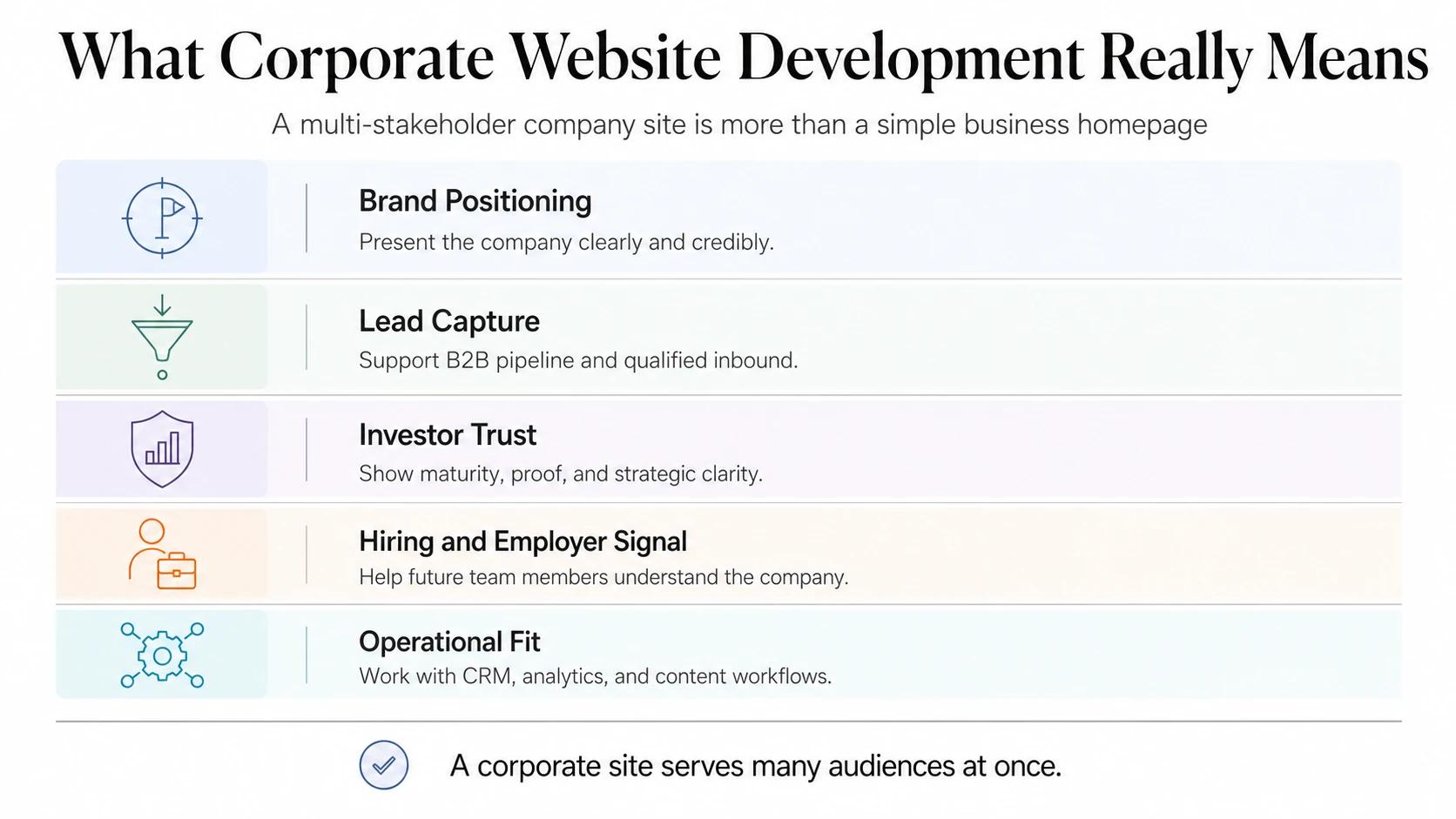
At Parallel HQ, I've seen early-stage B2B SaaS companies make the same mistake repeatedly: they scope their corporate site like a brochure and then spend twice the original budget rebuilding it 18 months later because it can't support their sales motion. The right framing is that a corporate website is a demand-generation asset, not a digital brochure.
Key capabilities that separate corporate sites from standard business sites:
- Multi-team content governance via a mature content management system
- REST API-ready architecture for CRM and marketing stack integration
- WCAG 2.1 accessibility compliance for enterprise procurement requirements
- Responsive design framework validated across all device classes
- Conversion rate optimisation built into the page architecture, not added as an afterthought
- Google Search Console verification and Core Web Vitals tracking from day one
A corporate site is accountable to revenue. Every page should have a clear job, and that job should connect to either pipeline, trust, or retention.
What Does Corporate Website Development Actually Cost in 2026?
Mid-market and corporate marketing sites represent the highest-value segment of lead-generation web development. Budgets typically span $15,000 to $75,000 for a complete project, with the median per Clutch 2026 data sitting at $36,500.
Breaking that number down into phases is how you sanity-check any agency proposal:
Enterprise builds show the widest spread, 36% of agencies quote $20,000–$50,000, while 7% go as high as $200,000–$500,000.
The invoice you receive on day one is rarely the actual cost, the real cost of a professionally built website is 100–200% higher when you factor in hosting, maintenance, integrations, and post-launch updates.
Three costs founders consistently underestimate:
- Third-party integrations: Each CRM, marketing automation, or Salesforce integration adds $1,000–$10,000 per connection.
- Content creation: Copy, imagery, and video can account for 20–40% of your total budget.
- Accessibility compliance: A proper accessibility audit after launch costs more than building it in correctly at the design stage.
Best Platforms for Corporate Website Development in 2026
Platform selection is an architectural decision, not a preference. The wrong CMS creates bottlenecks that affect every future campaign, content update, and integration. Here's how the main options stack up for corporate needs:
WordPress powers over 43% of all websites worldwide, making it the default choice, but "default" is not always "optimal." Choosing between Webflow and WordPress is not just a matter of technical preference. In practice, this decision affects budget, maintenance, design freedom, speed of launch, security, and the level of autonomy of the team that will manage the site afterward.
Our Webflow design and development services and WordPress design and development services are built around this exact decision point. We run a structured discovery before recommending a platform, because the architecture has to serve the business model, not the other way around.
For startups moving fast with strong design requirements, Webflow is frequently the right call. For organizations with complex content governance needs or deeply custom integrations, a headless CMS with a REST API layer is worth the higher upfront investment.
The Corporate Website Development Process: Step by Step
Most projects take 8–16 weeks from discovery to launch.
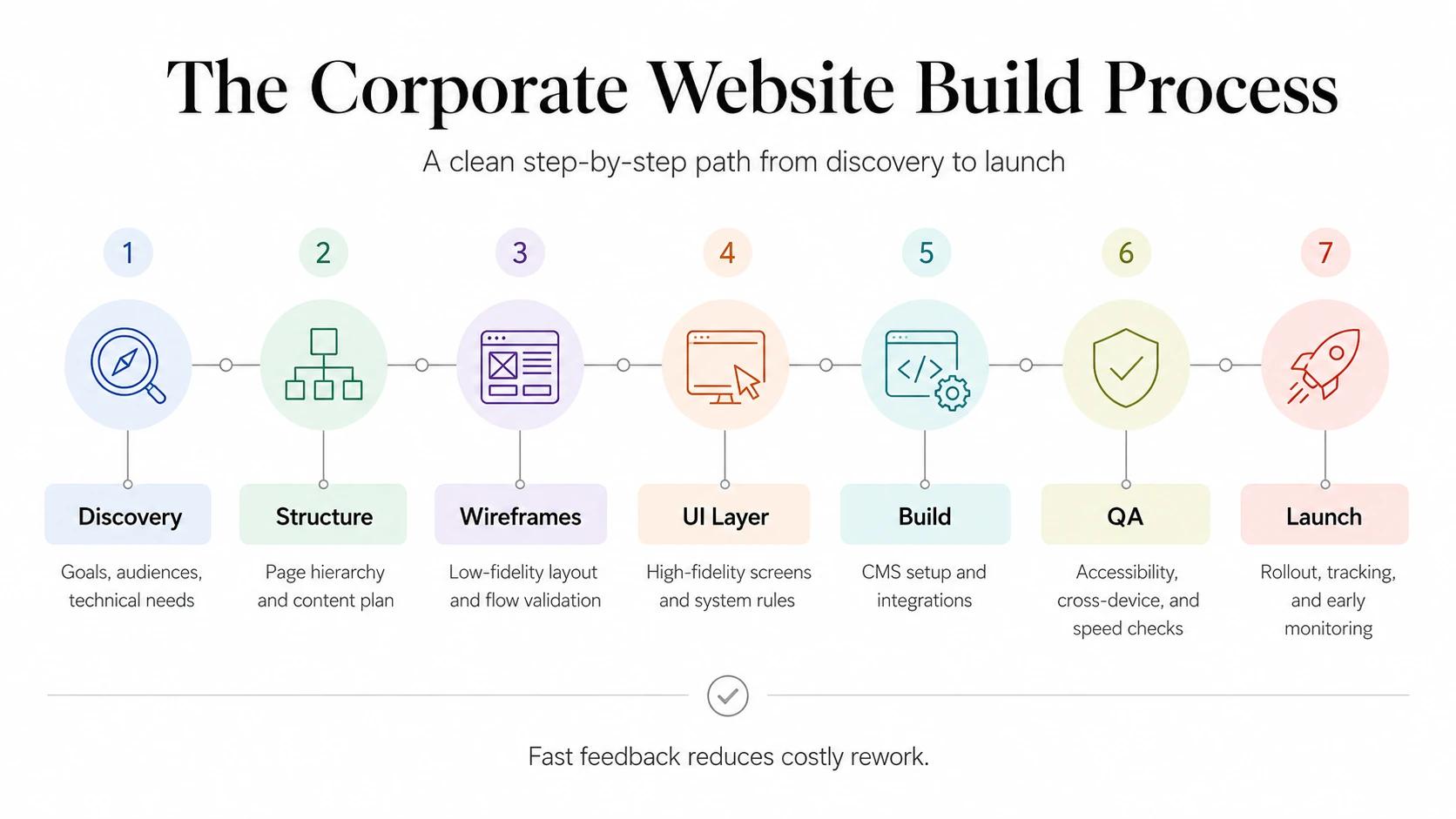
Here's what a well-structured process looks like:
- Discovery and stakeholder alignment (weeks 1–2): Map business goals, primary audiences, competitive positioning, and technical requirements. This is where product strategy consulting delivers the most leverage, bad assumptions here compound through every subsequent phase.
- Information architecture and content strategy (weeks 2–3): Define site structure, page hierarchy, navigation logic, and content requirements. Every URL should have a defined job.
- Wireframing and prototyping (weeks 3–4): Build low-fidelity wireframes in Figma to validate layout and user flows before any high-fidelity design begins. Our wireframing and prototyping service ensures stakeholders align on structure before visual design starts.
- UI/UX design (weeks 4–6): Translate brand identity system into a full responsive design framework. Every component is documented in a design system before handoff.
- Development build (weeks 6–10): Frontend development, CMS configuration, REST API integrations, Salesforce or HubSpot CMS connections.
- QA, accessibility, and performance testing (weeks 10–12): WCAG 2.1 compliance checks, Core Web Vitals benchmarking, cross-device testing, Google Search Console setup.
- Launch and post-launch monitoring (weeks 12–16): Staged rollout, 301 redirect mapping if migrating, analytics baseline, and conversion rate optimisation review at 30 days.
Delays in reviewing design mockups, providing content, or making decisions can stall progress. Quick and thoughtful feedback allows teams to move forward and avoid costly rework.
What Features Should a Corporate Website Have in 2026?
The features list is where corporate website development separates from vanity builds. Every element below should connect to a business outcome:
Lead generation and pipeline features:
- Gated content and demo request flows with CRM integration
- Landing page design optimized for paid and organic traffic
- Live chat or conversational interfaces tied to sales routing
Performance and technical features:
- Core Web Vitals compliance, Core Web Vitals are official Google ranking factors that directly affect SEO ranking, user experience, and conversion rates. Even a one-second delay can reduce conversions by 4.4%.
- WCAG 2.1 accessibility compliance for enterprise procurement eligibility
- W3C Web Standards-compliant, semantic HTML for SEO and screen reader compatibility
- Mobile-first responsive design (validated against real device data)
Content and governance features:
- Role-based content management system with editorial workflow
- Structured content model that supports future headless CMS migration
- Blog, resource center, and case study architecture for B2B lead generation via SEO
Trust and credibility signals:
- Client logos, case studies, and social proof positioned above the fold on key pages
- Security certifications, compliance badges, and privacy-compliant cookie architecture
- Investor relations or press sections for companies approaching Series A/B
Stacking features without a conversion architecture underneath them is expensive noise. Every feature should map to a specific user decision you're trying to influence.
Our UX audit service and B2B CRO suggestions exist specifically to identify feature gaps and conversion leaks in corporate sites that are already live.
Common Mistakes in Corporate Website Development
Most failures in corporate website development are not technical, they're strategic. Here's what I see consistently:
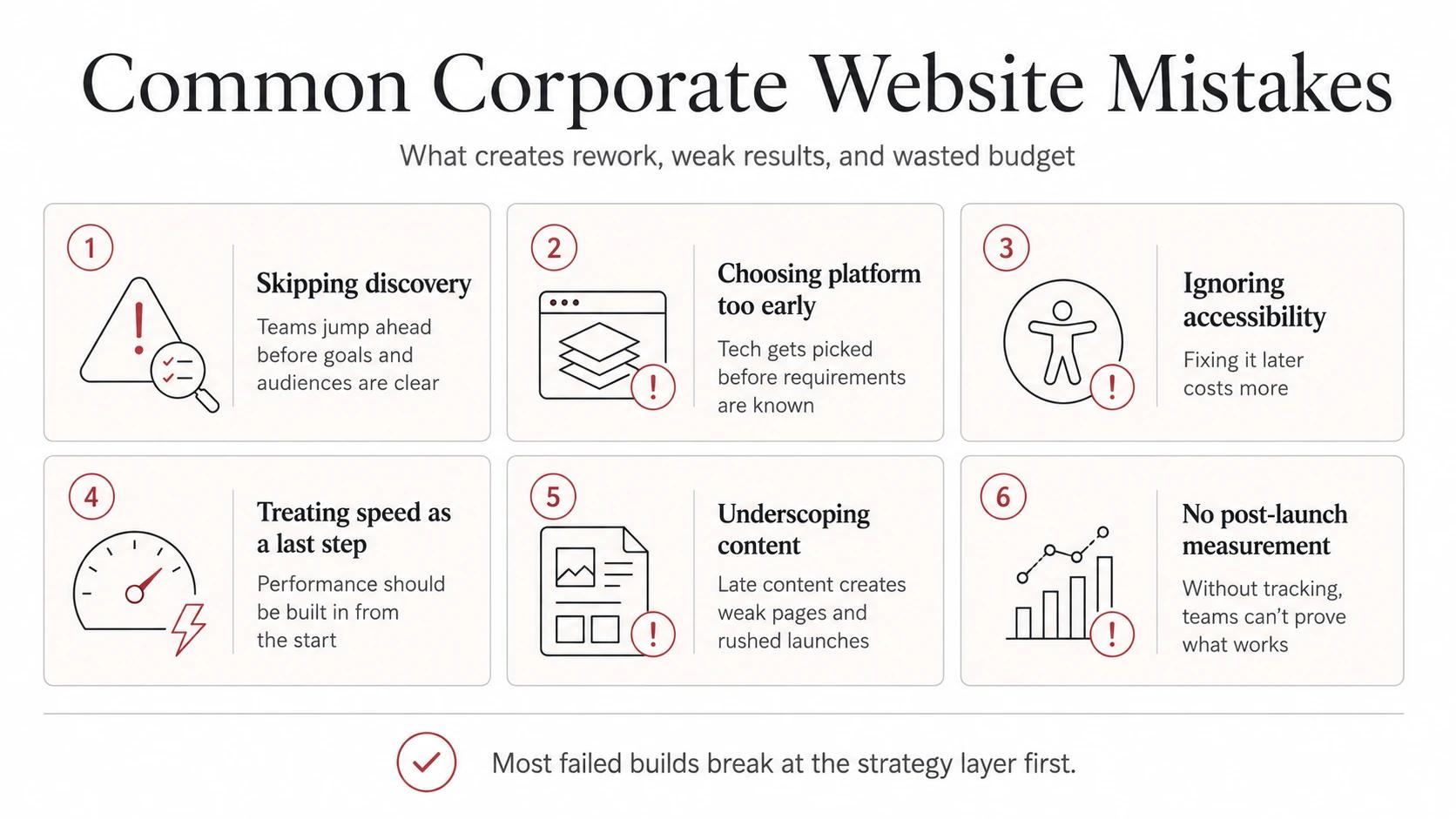
- Skipping discovery: Teams jump to design because it feels like progress. Without a structured discovery framework, the site gets built around internal assumptions rather than how buyers actually evaluate vendors.
- Choosing the platform before defining requirements: What really matters is the nature of the project, a business website, blog, corporate site, landing page, or a more complex environment with specific requirements. Platform first, requirements second is backwards.
- Treating accessibility as optional: WCAG 2.1 compliance is increasingly a contractual requirement for enterprise B2B sales. Retrofitting it post-launch costs 3–5x more than building it in.
- Ignoring Core Web Vitals during build: Pages loading within 2 seconds have a 9% bounce rate, while those taking 5 seconds see rates jump to 38%. Performance has to be designed in, not optimized out after the fact.
- Underscoping content: Most startups arrive at development with 20–30% of their content ready. The rest gets scrambled in the last two weeks, resulting in placeholder copy going live and never getting updated.
- No post-launch measurement plan: Without baseline Google Search Console data and Core Web Vitals benchmarks set at launch, there's no way to prove the site is performing or diagnose why it isn't.
- Building without a design system: One-off designs for each page mean every future update is a custom project. A proper design system cuts ongoing maintenance cost significantly and keeps the brand identity system consistent at scale.
Conclusion
Corporate website development done right is a strategic investment with measurable returns on pipeline and brand. The key decisions are front-loaded:
- Scope discovery seriously before any design work begins.
- Choose your platform based on content governance and integration requirements, not aesthetics.
- Build Core Web Vitals compliance and WCAG 2.1 accessibility into the process, not the punch list.
- Plan for 8–16 weeks and a realistic post-launch measurement window.
If you're an early-stage AI or SaaS startup evaluating your next site build or redesign, Parallel HQ's website redesign service or a UI/UX design engagement is the right starting point.
Frequently Asked Questions
Q1: What is the difference between a corporate website and a business website?
A business website typically serves one audience with a single goal, such as bookings or product sales. A corporate website serves multiple stakeholders simultaneously, investors, enterprise buyers, candidates, and press, with distinct content tracks and lead generation architecture for each. The technical and content complexity is substantially higher.
Q2: How long does corporate website development take in 2026?
Most projects take 8–16 weeks from discovery to launch, with complex sites requiring more time for integration and testing. Compressed timelines below 8 weeks typically produce rework within 6 months. Discovery, content readiness, and stakeholder review speed are the biggest schedule variables.
Q3: Should I use custom development or WordPress for a corporate website?
It depends on content volume and integration complexity.
WordPress powers over 40% of the web, is highly customizable with thousands of themes and plugins, and is ideal for blogs, small businesses, and e-commerce sites. For design-led startups needing fast iteration and strong Core Web Vitals, Webflow is often a better match. Custom or headless builds suit enterprises with complex permissions or multi-region content needs.
Q4: What does corporate website development cost for a startup in 2026?
Small to mid corporate sites typically land between $12,000 and $45,000, while eCommerce, SaaS MVPs, portals, and marketplaces range from $25,000 to $250,000+ depending on complexity, integrations, and team. Budget an additional 20–40% for content, and factor in ongoing hosting and maintenance retainers from day one.
Q5: What are Core Web Vitals and why do they matter for a corporate site?
Core Web Vitals are official Google ranking factors that directly affect your SEO ranking, user experience, and conversion rates. They measure loading speed (LCP), visual stability (CLS), and interactivity (INP). For B2B sites competing on branded and category search terms, strong Core Web Vitals scores are a meaningful ranking tiebreaker and a direct conversion lever.
Q6: How do I measure whether my corporate website is actually performing?
Set up Google Search Console at launch to track impressions, clicks, and indexing health. Establish Core Web Vitals baselines immediately post-launch. Track demo request conversion rates, time-on-page for key service pages, and bounce rate on entry points from paid campaigns. A UX audit at 60–90 days post-launch typically identifies the highest-leverage optimisation opportunities before they compound into a lost pipeline.

As the Founder and CEO of Parallel, Robin spearheads a pioneering approach to product design, fusing business, design and AI to craft impactful solutions.


