What Is Product Sense? 2026 Guide to Building the Skill
What is product sense? Discover the 2026 definition and learn how to build this essential PM skill. Get expert tips on identifying user needs and design.
Table of Contents
In 2018 I was part of a tiny team building an onboarding flow for a B2B SaaS tool. Our analytics said that sign‑ups were high but activation lagged. We had pages of data, a backlog full of requested features and a CEO who wanted us to ship faster. Late one night I scrolled through support tickets and watched a few user sessions. A pattern jumped out: people didn’t understand why they should finish onboarding. Instead of adding yet another tooltip or metric, we tried something else.

We simplified the flow to one screen, clearly stated the value of completing setup and added a short video of a real customer using the tool. Retention improved by 30%. On paper this wasn’t obvious, but instinct told us users needed clarity and reassurance. That instinct — often described as product sense — comes from experience, empathy and seeing patterns others miss.
Understanding what product sense is vital for anyone shaping products. In recruiting loops, hiring managers test it; in boardrooms, it separates clarity from confusion. In the pages ahead, I’ll explain what the term means, outline its main components, show why it matters, and share practical ways to build your own product instincts. Throughout, I’m speaking to founders, product managers and design or product leaders at early‑stage startups who want to make better decisions with limited time and resources.
What is product sense?
Whenever someone asks me what product makes sense, I offer a simple answer. It’s the ability to see through complexity and spot the user's need that matters most. In the pages that follow, I’ll expand on that, but keep this practical definition in mind.
Why call it a sense?
People often talk about product sense as if it were an innate ability — a sixth sense that some folks have and others do not. The word sense implies intuition rather than analysis, and that’s part of the confusion. Marty Cagan of the Silicon Valley Product Group argues that the term is misleading because it suggests a gift, when in reality strong product sense is better described as deep product knowledge built through immersion. He emphasises that spending quality time with customers, analysing competitors and diving into data are what create that kind of knowledge. In other words, the sense is not magical; it’s the pattern recognition that emerges from repeated exposure.
How experts describe it
Different sources define the concept in complementary ways:
- Creative empathy – Jules Walter explains that product sense is the skill of consistently crafting products that achieve the desired impact on users. It relies on empathy to discover meaningful user needs and creativity to devise solutions.
- Holistic decision‑making – According to ProductPlan’s learning centre, a well‑developed product sense combines creative problem solving, strong customer empathy and a deep understanding of context. It helps you anticipate trade‑offs and recognise which ideas to pursue and which to drop.
- Product knowledge – Marty Cagan insists that the quality comes from immersion in a product space. He points out that by spending time with customers, studying competitors and absorbing industry trends, you eventually build a foundation that lets you predict behaviours and outcomes.
- Problem framing – Sondra Orozco describes it as thinking critically and creatively about a product’s strengths and weaknesses. It involves looking past your own preferences to anticipate how a broader market will react.
- Addressing needs under ambiguity – Shreyas Doshi tells Exponent that product sense is the ability to make correct decisions when faced with considerable ambiguity.
Taken together, these definitions show that product sense is not limited to aesthetics or user interface. It is a fusion of empathy, context, creativity and disciplined analysis. Crucially, it is a learned skill. The Dovetail editorial team stresses that product sense takes dedication and time to craft, while Cagan and Walter both emphasise that nobody is born with it.
What it isn’t
Understanding what product sense is also means clearing up common misconceptions:
- Not just design instinct – It goes far beyond selecting colours or deciding whether a button is round or square. Pure UI intuition might improve aesthetics, but product sense factors in user value, business outcomes and technical feasibility.
- Not data vs. gut – Some equate product sense with gut feeling. Data drives decisions in modern teams, and A/B tests are essential, yet ignoring your instincts entirely is dangerous. ProductPlan notes that ignoring instincts is logical only if you haven’t honed the right ones.
- Not a birthright – Many assume people either have it or don’t. Cagan writes that the term “sense” implies innateness, but he argues that strong product sense comes from deliberate effortsvpg.com. Lenny’s survey of about 1 000 product managers shows that product sense can and must be developed.
- Not only about revenue – A pure business mindset without user empathy can lead to feature bloat or misalignment. Good product sense balances market opportunity with human needs.
Similar terms
To clarify what is product sense, it helps to compare it with related terms. You may hear phrases such as product thinking, product intuition or product judgement. Product thinking often refers to the broader mindset of defining vision, strategy and roadmaps. Product judgement relates to prioritisation and trade‑off decisions. Product sense is the more immediate instinct that bridges these: it’s the ability to recognise whether an idea will improve user experience and move the business in the right direction. As Cagan notes, it’s like having a compass during discovery.
Why product sense matters
Answering the question of product sense also clarifies why it matters. For founders and product managers, strong product sense is more than a nice‑to‑have — it’s a difference‑maker. Here’s why:
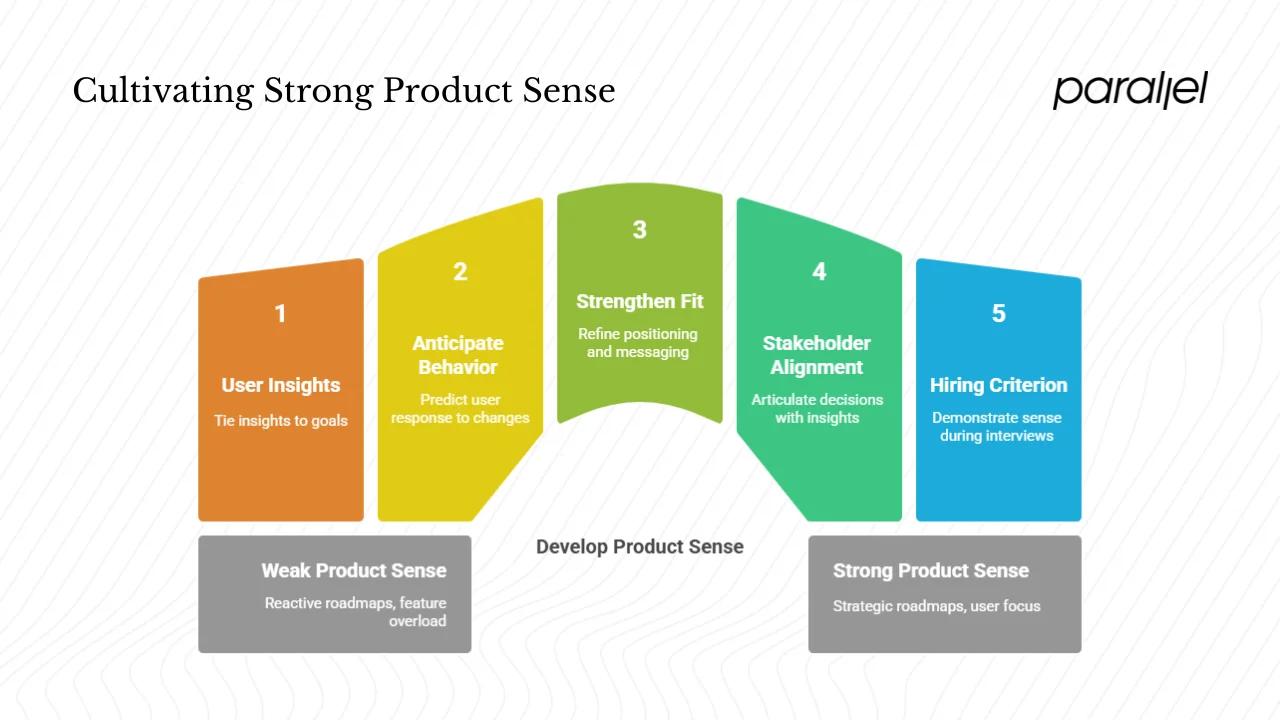
1) It bridges strategy, vision and execution
Roadmaps often collapse under the weight of competing requests. When time and resources are limited, you need to decide what to build and what to defer. Product sense helps prioritise because it ties user insights to strategic goals. It lets you see how a small feature will contribute to the bigger picture and avoid busy work.
2) It anticipates behaviour and market shifts
Great PMs predict how users will respond to changes. They watch how needs evolve and adapt accordingly. Lenny’s article gives examples of products born from this ability: the original iPhone recognised that people value aesthetics as well as functionality; Gmail saw unmet needs around storage and search; Superhuman focused on fast workflows for busy professionals. Each product succeeded by sensing unarticulated needs before competitors did.
3) It strengthens product‑market fit
When you deeply understand your users and the market, you can “feel” what will resonate. This sense helps you refine positioning, messaging and feature sets to fit your target segment. Without it, teams may chase vanity metrics or copy competitors, resulting in a bloated product that doesn’t solve anyone’s real problems.
4) It aids stakeholder alignment
Convincing engineers, marketers and executives requires more than intuition; you need to articulate why a decision is the right one. When you have a strong product sense, you can explain trade‑offs, anticipate objections and back up your view with insights. This fosters trust and speeds up decisions.
5) It’s now a hiring criterion
Most companies test for product sense during interviews. Lenny’s survey found that it’s one of the top skills employers value in product roles. Candidates are asked to analyse products, identify user pain points and propose improvements. Your ability to demonstrate product sense can decide whether you land the job.
6) Risks of weak product sense
Ignoring product sense leads to reactive roadmaps, feature overload and misalignment. Without it, teams chase random feedback, over‑invest in low‑impact work and confuse customers with incoherent experiences. Weak product sense also makes it hard to say no, leading to bloated products and missed opportunities.
The pillars of product sense
Another way to explain what is product sense is to break it into its core components. Several components work together to create product sense. Think of them as muscles you build over time. Each pillar below reflects a cluster of ideas and skills. I'll summarise key ideas in tables for clarity.
Signals of strong product sense
How can you tell when someone has a well‑developed product sense? Here are common behaviours:
- They identify strengths and weaknesses quickly. When reviewing a product, they notice friction points, missing states and delightful touches within minutes. They can explain why something works or fails without hand‑waving.
- They predict user reactions. Based on empathy and pattern recognition, they can say, “Users will probably abandon here because there’s no feedback,” and are often right. This comes from watching many people use products.
- They propose solutions with rationale. Instead of random ideas, they explain the user's need, the hypothesis and how the solution addresses it. They consider constraints up front.
- They ask insightful questions. People with product sense probe trade‑offs (“Who suffers if we cut this?”), dependencies (“Do we need the API ready first?”) and metrics (“How will we know this works?”). They often ask why more than what.
- They show curiosity and depth. They continuously study products, industries and human behaviour. They attend user interviews even when not required, read research and learn from other domains.
- They trust but verify. Good product sense includes the ability to sense when something is off even with incomplete data, but it doesn’t replace validation.
Communities often sum it up well. One Reddit comment described product sense as “a specific way of breaking down user problems and coming up with a framework for how to address them.” Another said it’s like “smelling what the customer really wants before they realise it themselves.”
Building and strengthening product sense
When people ask what is product sense in practice, I point them to habits that cultivate it. Developing product sense takes deliberate practice. Here are methods I’ve used personally and with clients to build this skill. I’ve grouped them into habits you can incorporate weekly or monthly.
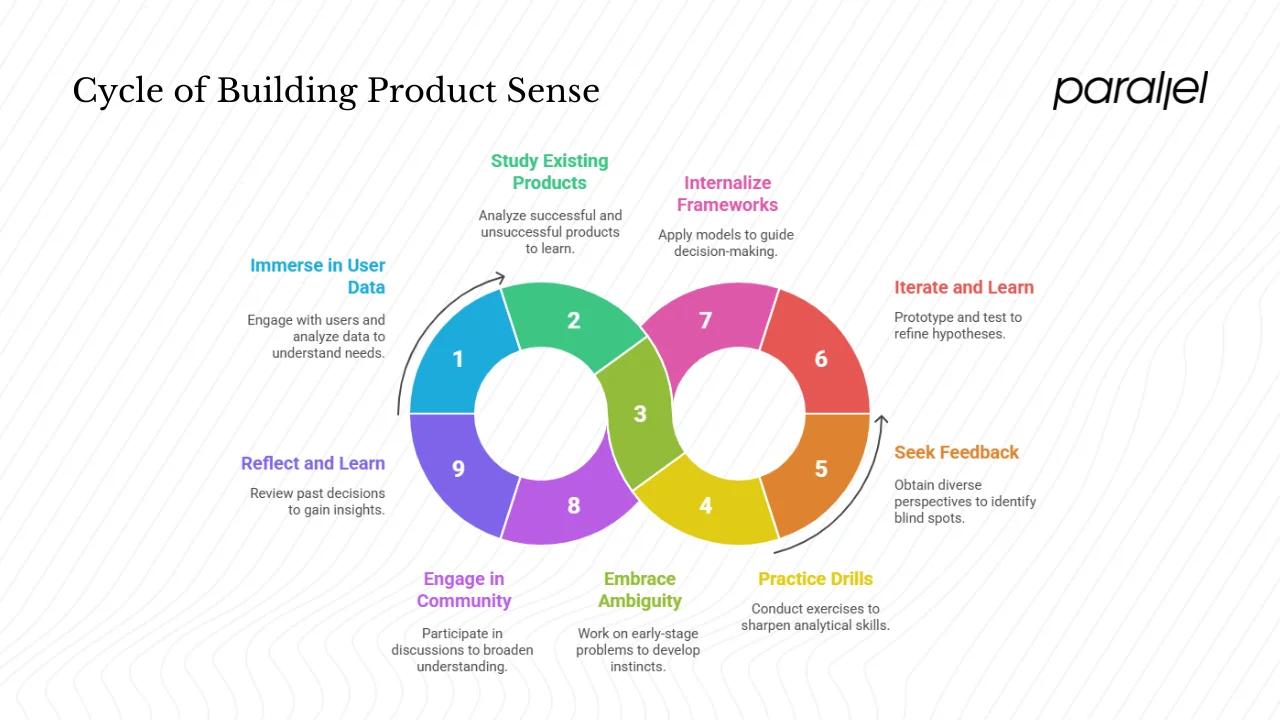
1) Immerse yourself in users and the domain
- Talk to users regularly. Schedule interviews, run usability tests and read support tickets. Ask open‑ended questions and watch body language. For B2B products, join sales calls and customer support chats.
- Shadow users at work. Sit beside a customer as they perform tasks with your product or a competitor’s. You’ll see context that surveys miss: environment, interruptions, workarounds and emotional cues.
- Live in the data. Combine qualitative insights with analytics. Look at funnel drop‑offs, heatmaps and session replays. Patterns in numbers often hint at unspoken pain points.
- Study adjacent industries. Inspiration often comes from outside your niche. If you’re building a financial tool, examine how gaming companies onboard users or how social apps encourage sharing.
2) Study existing products
- Reverse‑engineer why they work (or fail). Break down successful products like Airbnb or Figma. Exponent points out that Spotify recognised users wanted instant access to music with no hassle, Airbnb spotted travellers seeking home‑like stays and Figma solved collaboration pain. Ask yourself: What core need did they address? How did they balance trade‑offs?
- Compare competitors. Use your product and its rivals back to back. Document differences in flow, messaging and feature priority. Look for gaps your product could fill.
3) Embrace ambiguity and constraints
- Work on early‑stage problems. Early‑stage features or new products come with little data. Put yourself in those situations to strengthen your hypothesis‑driven thinking. At Parallel we often start projects with nothing more than a problem statement and a few assumptions; forcing ourselves to decide what to test first builds instincts.
- Impose limits. Constrain time, resources or scope intentionally. For example, try designing a mobile onboarding flow that must be completed within 30 seconds or an enterprise feature that can be built in a week. Constraints breed creativity and sharpen product judgement.
4) Practice product sense drills
- Critique random products. Pick a product you use daily (for example, your food delivery app) and list three things you love and three things you would change. Explain why.
- Feature teardown challenges. In product communities, people practice by taking a well‑known product, outlining user needs, brainstorming improvements and justifying them. Doing this regularly trains your analysis muscles.
- Mock interviews. Work with peers to answer typical product sense interview questions. Practice framing problems, generating solutions and discussing trade‑offs out loud. Exponent’s product sense question bank can help.
5) Seek feedback and critique
- Share your thought process. When proposing a feature, include your rationale: user insight, hypotheses, options considered and why you chose one. Invite peers to challenge your assumptions.
- Invite designers and engineers early. Cross‑functional perspectives catch blind spots. A design peer might tell you that your flow is confusing; an engineer might highlight technical risks. Listening builds humility and broadens your understanding.
6) Iterate and learn quickly
- Prototype cheaply. Use low‑fidelity wireframes or clickable prototypes to test concepts quickly. Run A/B tests on messaging or flows to see how users respond. At Parallel, we often test sign‑up copy by sending variants to a small group and measuring click‑through.
- Observe results and adjust. Don’t treat experiments as binary verdicts. Use them to learn and refine your hypotheses. Lenny’s Slack onboarding example shows that small tweaks (such as removing address book permissions) can have outsized impact.
7) Internalise frameworks and mental models
- Jobs‑to‑be‑Done – Focus on the job the user hires your product to do. For instance, a project management tool isn’t hired to create tasks; it’s hired to make teams coordinate work easily.
- IMPACT model – ProductPlan’s IMPACT framework asks whether a problem is interesting, meaningful, for specific people, actionable, clear and testable. Asking these questions prevents you from chasing shiny features.
- Behavioural science – Reading about cognitive biases and decision psychology helps you predict how users will interpret interfaces.
- Business models – Understanding how your product makes money and how customers adopt it informs prioritisation. A free‑to‑premium tool might invest differently than an enterprise product.
8) Mentorship and community
- Join product groups. Participate in local meetups or online forums where product people discuss decisions. Hearing diverse perspectives broadens your own.
- Find a mentor. Someone with deep experience can critique your decisions, suggest resources and challenge your thinking. At Parallel we host monthly critique sessions where team members present decisions and receive feedback.
- Review others’ work. Looking at someone else’s product decisions and asking “Why did they do this?” builds reverse‑engineering skills.
9) Be patient and persistent
Strong product sense accumulates through repeated cycles of observation, decision‑making and learning. Cagan says there is no substitute for doing the homework. Track your progress by reflecting on past decisions: What did you overlook? Where did your instincts lead you astray? This reflection turns experience into insight.
Applying product sense across the lifecycle
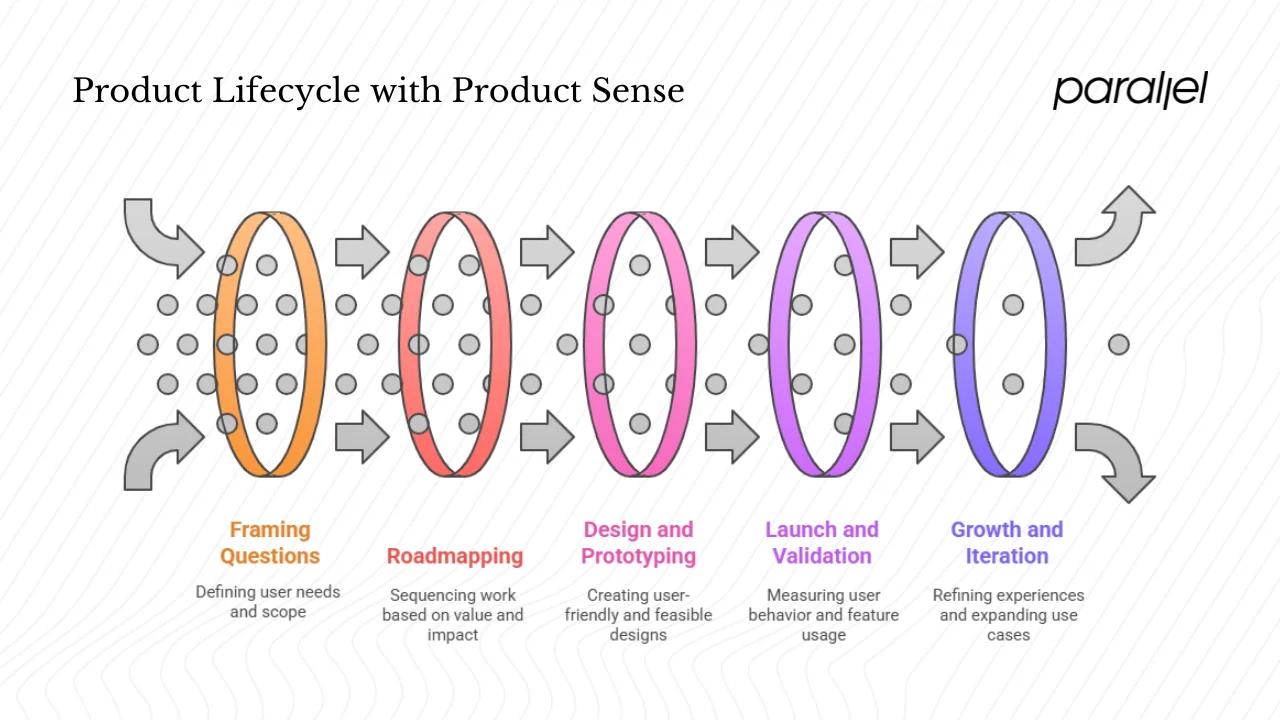
Product sense isn’t a step; it runs through the entire product lifecycle. Here’s how it shows up at different stages:
1) Ideation and discovery
When you’re identifying opportunities, product sense helps you ask the right questions. Who is struggling? What job are they trying to complete? Which pain is severe enough that people will pay to solve it? Use qualitative research, market analysis and brainstorming sessions to surface ideas. Product sense guides you to focus on a few promising directions instead of scattering your attention.
2) Framing questions and defining scope
Once you pick a problem area, use product sense to frame hypotheses. Define the user, the pain, the context and the desired outcome. Think carefully about scope: what’s the smallest testable product that could solve the problem? Resist the urge to include every request; good product sense disciplines you to cut features that don’t move the needle.
3) Roadmapping and prioritisation
As you create a roadmap, product sense helps you sequence work. It draws on your understanding of user value, business impact and technical complexity. Use scoring frameworks like RICE (reach, impact, confidence, effort) or Weighted Scoring to compare initiatives, but let product sense adjust scores based on qualitative insight.
4) Design and prototyping
During design, product sense informs the “critical path”: what steps must users take? Where are they likely to feel confused? How can you remove friction? It also keeps you honest about feasibility; don’t design interactions that are technically unviable. Collaboration between design, engineering and product should be tight here.
5) Launch and validation
When launching, product sense helps you pick metrics that matter. For example, focusing on daily active users might be less meaningful than measuring the number of users who complete a core workflow. After launch, watch how users behave. Are they using the feature as intended? Do they drop off? Use both data and follow‑up interviews to learn.
6) Growth and iteration
As your product matures, product sense guides which adjacent use cases to pursue. It helps you recognise when to refine existing experiences versus expanding into new domains. Continue to run experiments, collect feedback and revisit assumptions. Product sense is never finished; each cycle builds it further.
Case studies
Onboarding overhaul – A SaaS client of ours had a nine‑step onboarding process with multiple invitations, tooltips and form fields. Activation rates were low. By observing real sessions and asking users what they needed, we discovered that the abundance of choices paralysed them. We simplified the flow to three steps, pre‑filled certain details and communicated the benefit of completing setup. Activation improved by 30%, user satisfaction rose and support tickets dropped. Product sense drove us to cut features rather than add them.
Prioritising integration over novelty – A fintech startup believed they needed a chat bot to stand out. Market analysis showed competitors already offered similar features. Instead, we learned that users struggled to integrate transaction data into existing accounting systems. We shifted the roadmap to focus on a robust export API. The result: customers adopted the product more fully, and churn decreased. Product sense steered us away from novelty and toward the real need.
Challenges, pitfalls and misuses
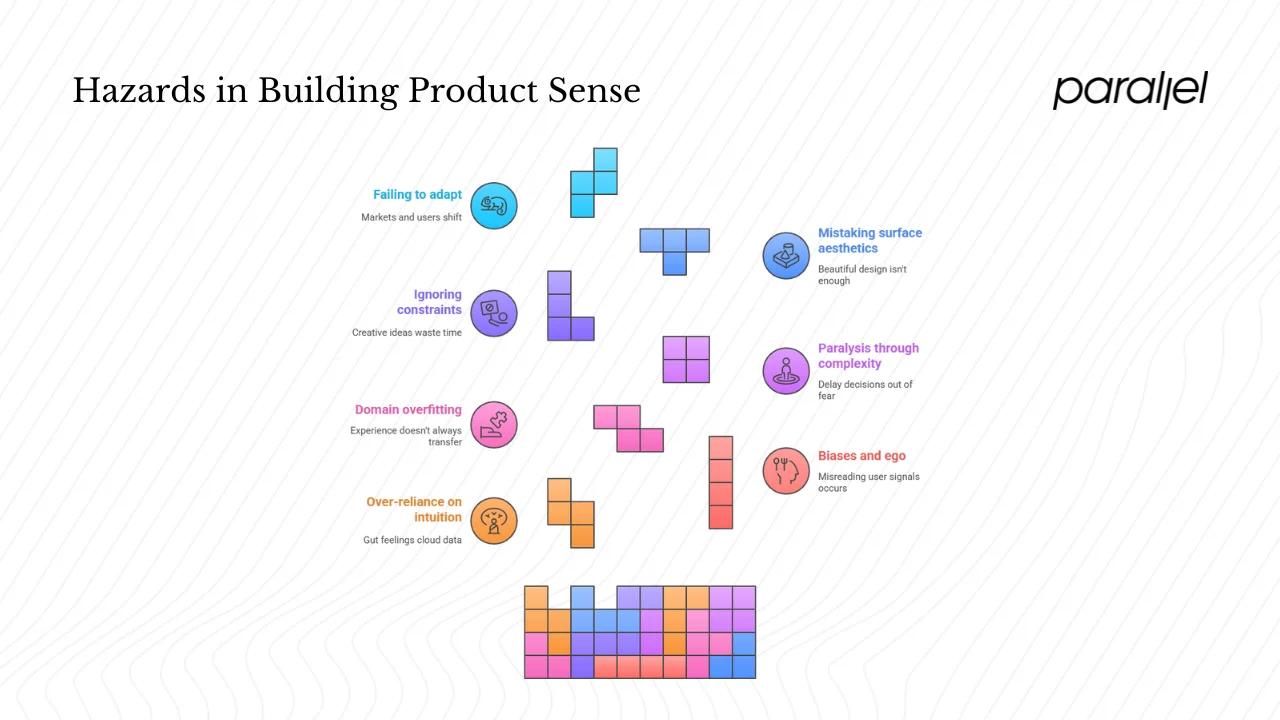
Building product sense is not without hazards:
- Over‑reliance on intuition – Gut feelings must be tempered by data. Even experts can fall prey to confirmation bias or recency bias. Always validate your ideas with research and experiments.
- Biases and ego – It’s easy to misread user signals through the lens of your own preferences or to cling to an idea because you championed it. Regularly challenge yourself to seek disconfirming evidence.
- Domain overfitting – As Cagan warns, deep experience in one domain doesn’t automatically transfer to another. Fresh perspectives matter; avoid assuming your past playbook will always apply.
- Paralysis through complexity – When faced with countless options, you might delay decisions out of fear of choosing wrong. Product sense develops by making decisions, learning and adjusting — not by avoiding action.
- Ignoring constraints – Creative ideas that ignore technical, regulatory or resource constraints waste time. Product sense requires balancing aspiration with realism.
- Mistaking surface aesthetics for product sense – A polished interface isn’t the same as solving the right problem. Avoid equating beautiful design with good product decisions.
- Failing to adapt – Markets change, competitors respond and user expectations shift. Product sense isn’t static; keep learning and stay curious.
Evaluating product sense
When we evaluate candidates or our own teams, we look for how they define and embody what is product sense. It’s not just about what they’ve built but how they think.
Interview questions and self‑checks
When hiring or assessing product sense, look for clarity, empathy and reasoning rather than correct answers. Sample prompts include:
- “Describe a product you love. What problem does it solve? What would you improve and why?”
- “Walk me through how you would design a solution for remote team collaboration when half your users are offline.”
- “What metrics would you track if you redesigned our onboarding?”
During answers, assess whether candidates define the problem clearly, consider user needs, weigh trade‑offs and communicate decisions with rationale. Look for structured thinking rather than scattershot ideas.
For self‑assessment, review past decisions and ask yourself:
- Did I identify the right problem? Would I still solve it the same way now?
- How well did I balance user value, business impact and feasibility?
- What feedback did I ignore? Why?
Peer critique sessions can surface blind spots. Encourage team members to bring recent decisions for group feedback.
Building a product‑sense culture
Product leaders can nurture product sense across teams by:
- Creating a feedback culture. Normalise critique sessions, post‑mortems and feature teardowns. When people feel safe sharing, the team collectively improves.
- Making users visible. Share user stories, research clips and analytics widely. The more everyone sees the customer’s reality, the better their instincts become.
- Designing rituals. Hold regular product tear‑downs where teams deconstruct a competitor’s product, discuss what works and what doesn’t, and learn.
- Hiring deliberately. Include product sense exercises in interviews, and look for candidates who demonstrate curiosity, empathy and clear reasoning.
- Maintaining consistency. As you scale across multiple squads, document decision frameworks and shared principles. Consistency doesn’t mean uniformity; it means shared understanding of how to think.
The future of product sense
The context in which we build products is changing. A few trends will shape how product sense is expressed over the next few years:
- Intelligent systems will influence decision‑making. As machine learning and generative tools become embedded in products, product people need to understand how algorithms impact user experience. The focus will shift from building features to orchestrating data flows and ensuring fairness, privacy and transparency. Cagan’s recent articles on “Product in the AI Era” emphasise that you still need deep product knowledge to apply these technologies responsibly.
- Platform and ecosystem thinking. Products are no longer standalone; they plug into ecosystems of APIs, integrations and marketplaces. Product sense will require a broader understanding of interdependencies and network effects.
- Cross‑domain perspectives. Breakthroughs often come from combining behavioural science, design, engineering and business. Teams will need to draw from varied disciplines to craft meaningful experiences.
- Faster learning cycles. With real‑time analytics and feature flagging, teams can test and iterate faster. This accelerates the feedback loop, but it also demands a keen sense of which experiments matter. Product sense will guide which hypotheses to test and when to pivot.
Mind the Product’s 2025 survey of over 600 product professionals highlights that 56% are focusing on machine learning, 35% want to strengthen leadership skills and 28% aim to expand technical skills. Building customer trust (17%) and doing more with less (16%) are also priorities. These trends suggest that product leaders must not only embrace new technologies but also maintain empathy, communication and frugality. Strong product sense will help teams adapt to these shifts.
Conclusion
So, what is product sense? It’s the practiced ability to spot genuine user needs, imagine solutions within constraints and make decisions that serve both people and business. It’s not an innate gift but a skill built through exposure, empathy and reflection. It blends creativity with analysis, pattern recognition with humility, and vision with reality. For founders and product leaders at early‑stage companies, cultivating product sense is one of the most worthwhile investments you can make.
As Robin Dhanwani, I’ve seen teams succeed not because they followed a rigid process, but because they listened deeply, experimented quickly and stayed curious. Building product sense takes time, but each decision you make — big or small — is a chance to strengthen it. My parting encouragement: pick one habit from this guide, whether it’s talking to users every week or critiquing a competitor’s app, and commit to doing it. With persistence, your instincts will sharpen and your products will improve.
Frequently asked questions
1) What is meant by product sense?
It’s the internal compass that guides you to craft products that people value. It combines empathy for users, awareness of the market, creativity in solution‑finding and the discipline to validate ideas. Multiple experts describe it as the ability to design products that address user needs while balancing constraints.
2) How can I demonstrate product sense?
In interviews, walk through how you frame problems, think about user segments, generate options, consider trade‑offs and validate your choices. In your work, propose decisions with clear reasoning, point out gaps or pain points in existing products and push back on ideas when evidence suggests they won’t help users.
3) Is product sense a skill?
Yes. Although some people pick it up quicker, most sources stress it’s cultivated over time. Cagan emphasises that it results from immersion in a product space, while Lenny’s newsletter affirms that product sense can be learned.
4) How long does it take to develop product sense?
It varies. Many find that after one to two years of intentional practice — observing users, deconstructing products, seeking feedback — their instincts improve noticeably. Growth continues for decades; even seasoned product leaders keep sharpening their senses.
5) Can designers or engineers build product sense?
Absolutely. Because product sense sits at the intersection of user, business and technology, designers and engineers who broaden their perspective and seek user empathy can develop strong product sense. In fact, cross‑functional teams benefit when everyone brings product instincts to the table.
6) How is product sense different from product thinking or product strategy?
Product sense is the immediate ability to make decisions that feel right for users and business. Product thinking is a broader mindset about vision, strategy and planning. Strategy deals with positioning, market selection and resource allocation. Product sense is how you apply these high‑level choices to day‑to‑day decisions.

As the Founder and CEO of Parallel, Robin spearheads a pioneering approach to product design, fusing business, design and AI to craft impactful solutions.


