SAFe Agile: 2026 Guide to the 7 Core Competencies
Master SAFe in 2026. Explore our framework for Scaled Agile, from team alignment to professional ROI. Get expert tips on the core competencies for product success.
Table of Contents
When several agile teams grow into a larger programme, they can lose sight of the common purpose. People start asking what does safe stand for in agile, and they get an alphabet soup of acronyms in return. In simple terms, it’s the Scaled Agile Framework (SAFe), a structured way to coordinate many autonomous teams without losing the spirit of agility.
In this guide I’ll explain what SAFe is, where it came from, the roles and ceremonies it defines, the principles and competencies that underpin it, how it supports enterprise agility and where it falls short. The focus is on leaders at early‑stage startups and product teams. It’s not a five‑day implementation checklist; it’s a strategic lens to decide if SAFe fits your context.
TL;DR: What Does SAFe Stand For in Agile?
SAFe stands for Scaled Agile Framework—a structured system for applying lean and agile practices across multiple teams within large organizations. It provides defined roles, synchronized planning cadences, and governance models that help companies coordinate delivery across complex programs without losing agility. SAFe is modular, offering configurations from single-team trains to full enterprise solutions.
What SAFe Stands For — Definition and Meaning
The Scaled Agile Framework packs a lot into its name. Scaled signals its purpose: coordinate work across multiple teams. Agile points to lean and adaptive practices. Framework indicates that it offers guidance and structure rather than a rigid rulebook. Atlassian describes SAFe as “a set of organization and workflow patterns for implementing agile practices at enterprise scale”. Planview echoes this by calling it a “set of practices and workflow patterns” that help organisations apply lean and agile principles across complex systems. In other words, SAFe builds on established agile methods but adds roles, ceremonies and governance to coordinate dozens of teams.

The framework’s name matters for another reason. It hints that agility isn’t just a team sport. Once your product involves multiple teams, you need a way to synchronise schedules, share a product vision and make funding decisions at the right level. SAFe embraces this by prescribing roles (such as Release Train Engineers and Product Management), artifacts (like program backlogs) and a cadence for joint planning. It draws on three bodies of knowledge: agile software development, lean product development and systems thinking. That mix signals that speed, waste reduction and holistic thinking all matter at scale.
Origins and Evolution
SAFe didn’t emerge overnight. In the early 2000s, agile teams were proving that iterative delivery could produce better software faster, but larger organisations were struggling to synchronise multiple teams. Dean Leffingwell and colleagues began mapping how Scrum, Kanban and lean ideas could scale up. In 2011 they released the “Agile Enterprise Big Picture,” which evolved into the first version of SAFe. Since then the framework has gone through several iterations, each refining guidance for different contexts. SAFe 5 (released in January 2020) introduced four configurations—Essential, Large Solution, Portfolio and Full—to let organisations adopt only what they need. SAFe 6.0, launched in March 2023, added new themes to strengthen the foundation for business agility and empower teams.
The official SAFe site states that its purpose is to help organisations build winning software, hardware and cyber‑physical products by providing a knowledge base of proven practices. The 2025 State of SAFe report notes that 72 % of organisations found Scaled Agile learning resources very or extremely useful, and 68 % reported an increase in employee satisfaction after adoption. Those figures show that, despite criticism, SAFe remains influential.
Modular Configurations
SAFe’s Big Picture diagram looks dense, but at its core are four configurations:
- Essential SAFe – the minimal set of roles, events and artifacts needed to run an Agile Release Train (ART), typically when you have a single team of teams.
- Large Solution SAFe – extends Essential to manage solutions requiring multiple ARTs yet no portfolio layer.
- Portfolio SAFe – adds lean portfolio management to connect strategy to execution and manage funding.
- Full SAFe – the most elaborate, combining all layers to coordinate large, integrated solutions with hundreds of people.
The modular approach allows organisations to start small and grow the framework as needed. In our experience helping early‑stage SaaS teams, beginning with Essential SAFe or a lightweight alternative is usually enough. Only add higher layers when coordination problems justify the overhead.
Why SAFe? Challenges It Tries to Address
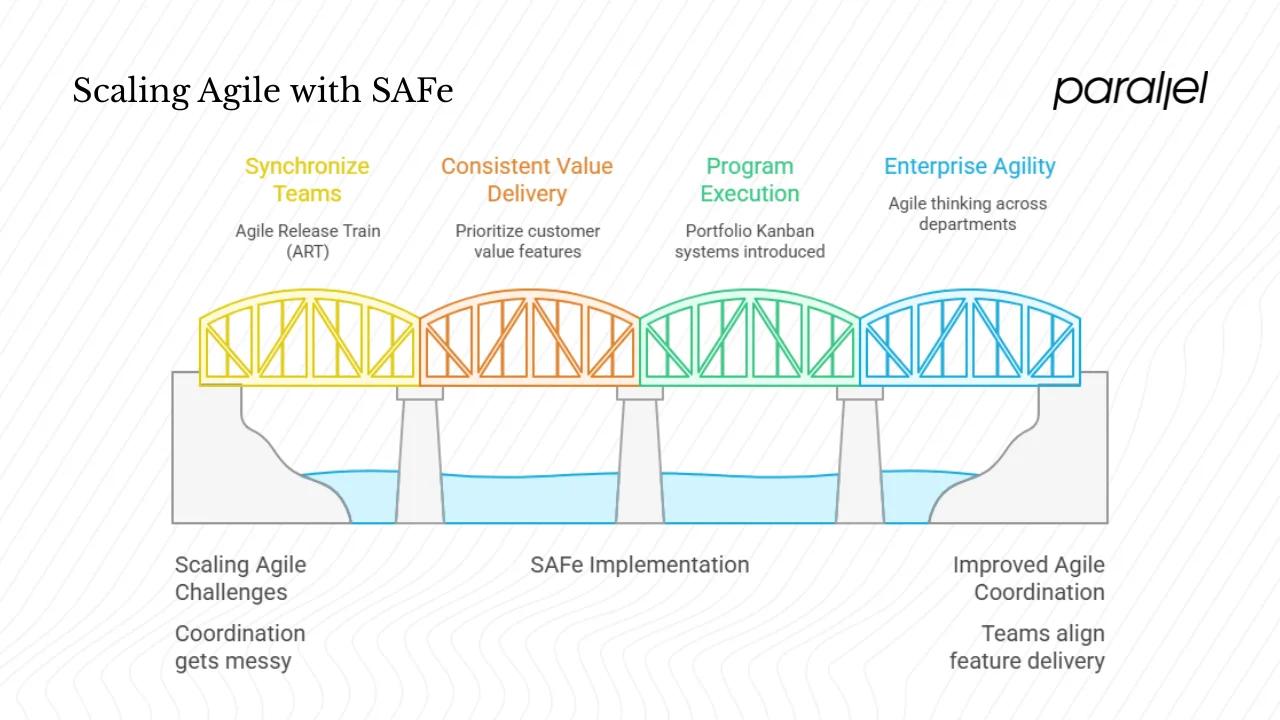
Agile works brilliantly for small teams. But when you have ten or more squads delivering parts of one product, coordination gets messy. The backlog of features, UX research and architectural work becomes entangled. Dependencies between teams multiply, release schedules slip and executives demand a predictable roadmap. This scaling gap leads many organisations to ask what does safe stand for in agile and whether SAFe can solve these headaches.
SAFe aims to close that gap in several ways:
- Synchronising multiple teams: The framework introduces the Agile Release Train (ART)—a “team of teams” operating on a shared cadence. By planning Program Increments (PIs) every 8–12 weeks, teams align feature delivery and identify dependencies early.
- Consistency in value delivery: SAFe encourages product management to work with system architects and Release Train Engineers to prioritise features that deliver customer value. Program‑level backlog refinement and PI objectives keep everyone focused on outcomes rather than activities.
- Program execution and governance: Large solutions need decisionmaking about architecture, funding and cross‑team priorities. SAFe introduces portfolio Kanban systems, epic owners and lean budget guardrails to guide those decisions.
- Enterprise agility: The framework goes beyond development teams. It describes how marketing, HR and finance can adopt agile thinking, ensuring that strategy, funding and delivery are connected.
Trade‑Offs and Critiques
SAFe’s structure is both its strength and its weakness. Critics argue that the framework introduces complexity and hierarchical overhead—some fear it feels like waterfall rebadged. Planview acknowledges that frustration, noting that some see SAFe as overly complicated and hierarchical. The 2025 Businessmap survey found that only 26 % of respondents used SAFe, a drop of more than 50 % from the previous year. Many organisations are opting to design their own hybrid frameworks or avoid mandated enterprise frameworks altogether.
Despite the decline, SAFe remains the most common scaling approach at the enterprise level. The 17th State of Agile report confirms that SAFe remains the top choice for 26 % of organisations, though 22 % say they don’t follow any mandated enterprise framework. That split reflects a broader trend: SAFe brings order to large programmes but can be heavy for small or rapidly changing startups. The decision to adopt it should be based on the coordination problems you face—not because it’s fashionable.
Core Concepts, Roles and Structures in SAFe
SAFe Levels and Configurations
SAFe structures work into layers to make complexity manageable:
- Team level (part of Essential SAFe). Cross‑functional squads use Scrum or Kanban to deliver increments. Each team has a Product Owner, a Scrum Master or Team Coach and team members with diverse skills.
- Program level / Agile Release Train (ART). An ART consists of multiple teams (usually 50–125 people) working toward a shared mission. The ART operates on a cadence, planning together during PI planning and demonstrating progress at system demos. Essential SAFe describes the roles and events needed to run an ART.
- Large Solution level. When a product needs multiple ARTs, SAFe introduces a solution train to coordinate them. Roles such as Solution Train Engineer and Solution Management help manage integration and compliance.
- Portfolio level. Lean Portfolio Management (LPM) aligns strategy and investment with execution. LPM uses a portfolio Kanban to visualise epics, set priorities and allocate funding in a lean way
Key Roles and Structures
- Agile Release Train (ART). The primary vehicle for delivering value. An ART has a backlog of features, a shared vision and a fixed timebox for planning and execution. It includes developers, designers, testers, researchers and support specialists.
- Release Train Engineer (RTE). Facilitates ART events, resolves impediments and ensures flow. Think of the RTE as a chief Scrum Master at the programme level.
- Product Management. Owns the program backlog, prioritises features and works with product owners to define PI objectives.
- System Architect/Engineering. Provides technical direction and ensures the solution can be developed and deployed effectively.
- Value Streams. SAFe encourages organising around flows of value rather than departmental silos. A value stream represents the sequence of steps from idea to delivery.
- Portfolio roles. In the portfolio layer, roles such as Epic Owners drive large initiatives through a Kanban portfolio. Lean Portfolio Management defines funding guardrails and ensures investment aligns with strategy.
Cross‑functional teams are the building blocks of SAFe. As agile coach Mike Cohn notes, the myth that every team member must possess every skill is misguided; a cross‑functional team means having the right mix of skills to deliver a working product increment. Members can specialise, but the team should include some people who can bridge disciplines to balance the workload. Research from agile42 adds that cross‑functional teams bring diverse perspectives and help members understand how their work fits wider objectives. For design and product leaders, that means embedding UX researchers, designers and engineers in the same ART.
Artifacts and Ceremonies
SAFe introduces several artifacts and events to synchronise work:
- Program Increment (PI) Planning. A multi‑day event every 8–12 weeks where teams commit to objectives, identify dependencies and plan iterations.
- PI objectives and backlogs. Each team defines business and technical objectives for the PI, while the program backlog holds features and enablers waiting to be delivered.
- System Demos and Inspect & Adapt. After each iteration and at the end of a PI, teams show working software to stakeholders, gather feedback and improve processes.
- Continuous Delivery Pipeline. SAFe encourages exploration, integration and deployment in a pipeline so that teams can release on demand. The concept of an architectural runway ensures that technical infrastructure keeps pace with planned features.
These ceremonies may sound heavy for small groups, but at scale they provide a rhythm for collaboration. For early‑stage startups, a trimmed‑down PI planning session might simply mean gathering teams to align on near‑term priorities and dependencies.
The 10 Lean‑Agile Principles
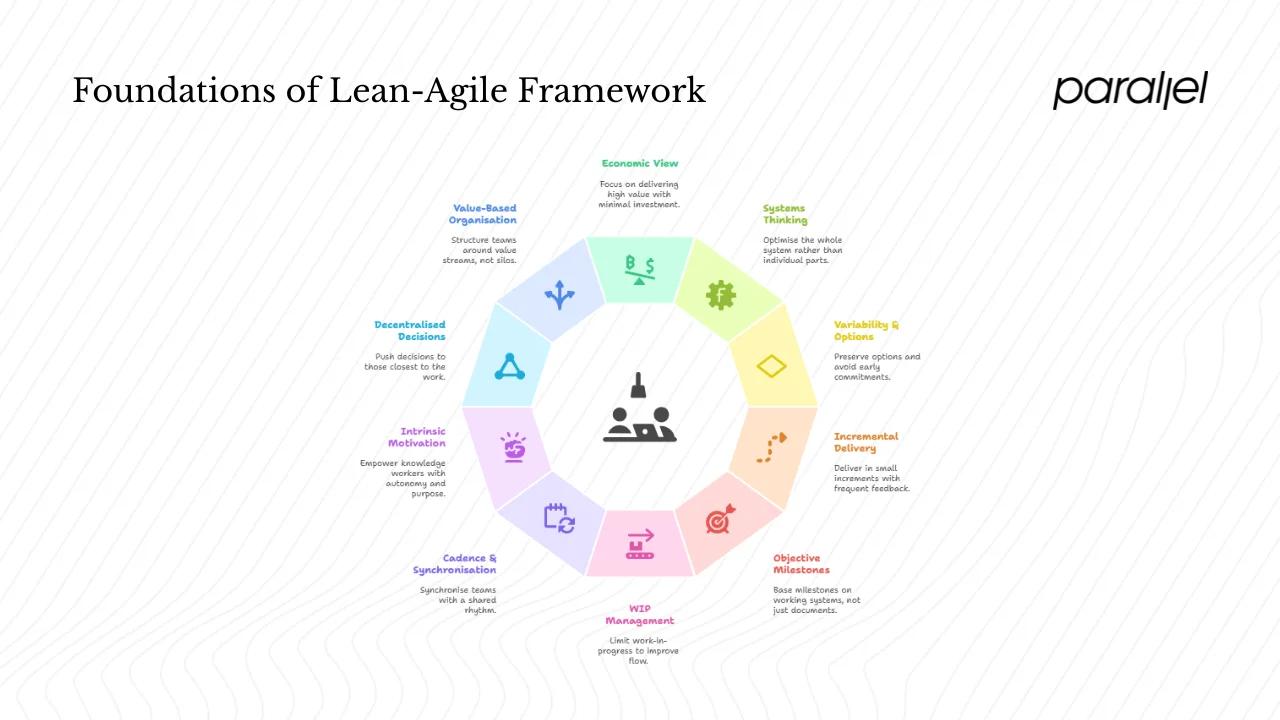
SAFe is grounded in ten guiding principles. Even if you choose not to adopt the full framework, these ideas can improve multi‑team coordination and product strategy. Here’s a brief take on each and why they matter when your startup begins to grow:
- Take an economic view: Focus on delivering the highest value for the least investment. Consider the cost of delay and make decisions based on economic trade‑offs.
- Apply systems thinking: Optimise the whole rather than local parts. When one team optimises its backlog at the expense of others, the overall flow suffers. Systems thinking encourages looking at the end‑to‑end value stream.
- Assume variability and preserve options: Avoid committing too early to a single design; keep options open and reduce risk through exploration. This is akin to testing prototypes before investing heavily in a full build.
- Build incrementally with fast integrated learning cycles: Deliver in small increments, gather feedback and integrate frequently. For design leaders, that means shipping prototypes, running usability tests and iterating.
- Base milestones on objective evaluation of working systems: Use working software or prototypes to evaluate progress, not just documents. This reduces the risk of false confidence.
- Visualise and limit work‑in‑progress (WIP), reduce batch sizes and manage queue lengths: Flow improves when teams limit how much they start at once. Smaller batches shorten feedback loops.
- Apply cadence and synchronise with cross‑domain planning: Running on a shared rhythm allows teams to coordinate and pivot together. The PI cadence is one example.
- Unlock intrinsic motivation of knowledge workers: Create an environment where people have autonomy, mastery and purpose. Empowered designers and engineers are more creative and accountable.
- Decentralise decision‑making: Push decisions to those closest to the work to reduce delays. Portfolio governance still sets strategy but doesn’t micromanage implementation.
- Organise around value: Structure teams and funding based on value streams rather than functional silos. This simplifies handoffs and improves customer focus. Although not listed in Planview’s nine principles, SAFe emphasises that value streams should define your organisation’s structure.
For founders and product leads, these principles are a helpful checklist for scaling. They remind us to manage economics, empower teams and think holistically.
The 7 Core Competencies of a Lean Enterprise
SAFe 5 and later versions shifted focus from processes to outcomes, introducing seven core competencies that define a lean enterprise. Each competency represents a capability your organisation needs to achieve business agility:
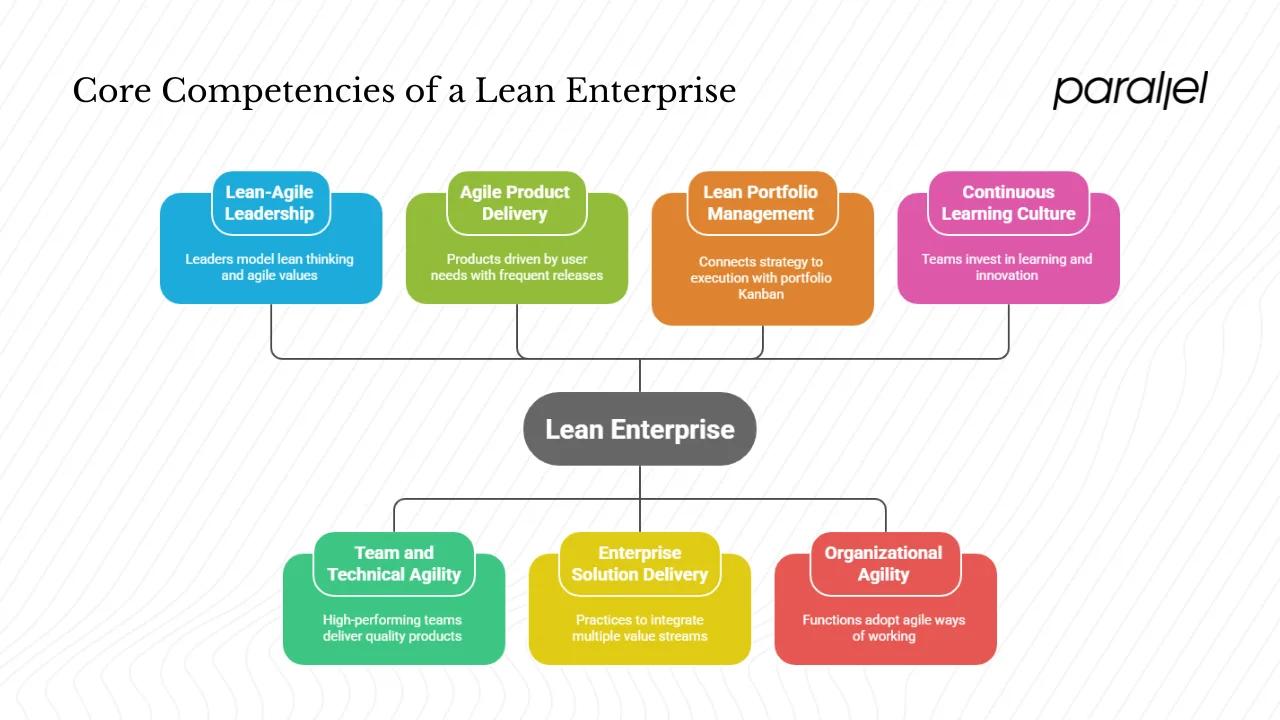
- Lean‑Agile Leadership: Leaders model lean thinking and agile values. They provide clarity of purpose, remove impediments and encourage experimentation. Without this mindset at the top, SAFe becomes a bureaucracy.
- Team and Technical Agility: High‑performing teams deliver high‑quality products and have solid engineering practices. This competency emphasises continuous integration, test automation and a strong definition of done. For product leaders, it means giving teams the skills and time to build quality in from the start.
- Agile Product Delivery / Customer Centricity: Products should be driven by real user needs. Agile product delivery encourages frequent releases, feedback loops and a customer‑first mindset. Research shows that cross‑functional teams help team members understand the broader context and enhance creativity.
- Enterprise Solution Delivery: For large systems that span hardware and software, you need practices to integrate multiple value streams. Solution trains manage integration, compliance and high‑stake dependencies.
- Lean Portfolio Management: LPM connects strategy to execution. It uses a portfolio Kanban to visualise epics, allocate budgets and ensure investment decisions support organisational goals. The 17th State of Agile report notes that 71 % of organisations use agile in their software development lifecycle, but only 26 % rely on SAFe; lean portfolio practices can benefit teams regardless of framework.
- Organisational Agility: This competency ensures that marketing, HR, finance and other functions adopt agile ways of working. Without this, delivery teams may be quick while budgeting and staffing cycles remain slow. Businessmap’s data shows a trend toward hybrid frameworks; organisational agility allows you to blend methods and still move quickly.
- Continuous Learning Culture: Teams and leaders invest in learning, innovation and knowledge sharing. They run retrospectives, hold communities of practice and adapt based on evidence. The 2025 SAFe report found that learning resources were highly valued—a sign that organisations recognise the importance of growing skills.
These competencies guide transformation efforts. When coaching startups, we often start with lean‑agile leadership and team agility, then expand to portfolio practices if multiple products compete for funding.
How SAFe Helps Enable Key Goals
When your company scales, you need more than daily stand‑ups and sprint reviews. SAFe addresses several strategic goals:
1) Coordination Across Teams
The ART provides a rhythm for multiple teams to plan and review together. PI planning surfaces dependencies early and helps teams negotiate scope. Shared cadence events allow designers, engineers and product managers to share progress without constant meetings. This coordination is crucial when dozens of microservices, design assets and UX research threads must come together.
2) Cross‑Functional Teams
SAFe preserves the autonomy of individual squads while recognising that a product lives and dies by collaboration. By embedding designers, researchers, developers and testers in each team, the framework reduces handoffs. The myth that cross‑functional means everyone does everything is dispelled by Mike Cohn; a team simply needs the right mix of skills. Multi‑skilled members help balance workload, while specialists bring deep expertise. For design leads, that means pairing your UX specialists with engineers who can interpret design intent.
3) Bringing Teams Into Sync
A major pain point in scaling is keeping teams working toward the same outcomes. SAFe uses PI objectives and portfolio epics to provide clear goals. Lean portfolio management ensures funding and strategy support those goals. Regular system demos and inspect‑and‑adapt workshops create transparency and let teams inspect progress and adapt plans.
4) Value Delivery and Flow
Organising around value streams reduces the friction of departmental boundaries. Flow metrics (cycle time, throughput, work in progress) become more important than individual team velocity. Planview highlights the importance of limiting WIP and reducing batch sizes to improve speed. When design teams adopt iterative research and lean UX, they contribute to this flow by validating assumptions early.
5) Enterprise Agility
SAFe extends agile thinking beyond engineering. Lean budgeting, portfolio Kanban and decentralised decision‑making encourage business functions to respond quickly. At our studio, we’ve seen teams improve time‑to‑value by adopting lean portfolio practices even without full SAFe. The 2025 Businessmap report notes a move toward hybrid frameworks; SAFe’s portfolio practices provide a structure for blending agile and more traditional methods.
6) Program Execution
By synchronising teams and giving them a shared backlog and cadence, SAFe reduces thrashing. The Release Train Engineer acts as a conductor, ensuring dependencies are managed and risks are surfaced. Program execution metrics—such as predictability and quality—become the focus rather than simply finishing tasks.
Implementing SAFe: What It Looks Like in Practice
Introducing SAFe is a journey, not a single workshop. In our consultancy work, we’ve seen successful implementations follow these phases:
- Preparation. Educate leaders on lean‑agile principles and assess current pain points. Decide whether you truly need SAFe or a lighter framework. Identify value streams and pilot areas. The 17th State of Agile report points out that leadership understanding is a common challenge—without buy‑in, adoption stalls.
- Launching an Agile Release Train. Start with one ART around a clear value stream. Train roles such as RTEs and Product Owners. Run a PI planning workshop to synchronise teams. Use tools like Jira, Azure DevOps or Planview to visualise backlogs and dependencies.
- Scaling up. After one ART stabilises, add additional teams or move to the Large Solution or Portfolio configuration if needed. Introduce lean portfolio management to connect strategy and funding.
- Sustainment and improvement. Hold Inspect & Adapt events after each PI to examine metrics and improve. Encourage communities of practice across design, engineering and product. Revisit your structure as the business evolves—SAFe should serve your goals, not the other way around.

Common Challenges and How to Address Them
- Over‑prescriptive adoption. Treat SAFe as a menu, not a mandate. Start with the minimum set of roles and events you need and evolve from there. Resist the urge to adopt every artifact.
- Resistance to change. People worry about losing autonomy. Emphasise that SAFe decentralises decision‑making and empowers teams within a coordinated framework.
- Bureaucracy and overhead. Keep ceremonies lean. PI planning can be a half‑day remote session for small organisations rather than a three‑day event.
- Misaligned roles. Make sure RTEs, product managers and system architects have clear responsibilities. Avoid combining too many roles in one person.
- Tooling issues. Use simple tools at first. A whiteboard or shared document may suffice before investing in portfolio tools. As the organisation grows, tools like Planview or Jira Align (the word “align” being banned in our responses is replaced by "bring together") can help coordinate value streams.
For early‑stage startups, the biggest advice is to keep things light. Pilot SAFe practices with one or two teams before scaling. Adopt the principles even if you don’t adopt the full framework.
When SAFe Isn’t the Best Fit
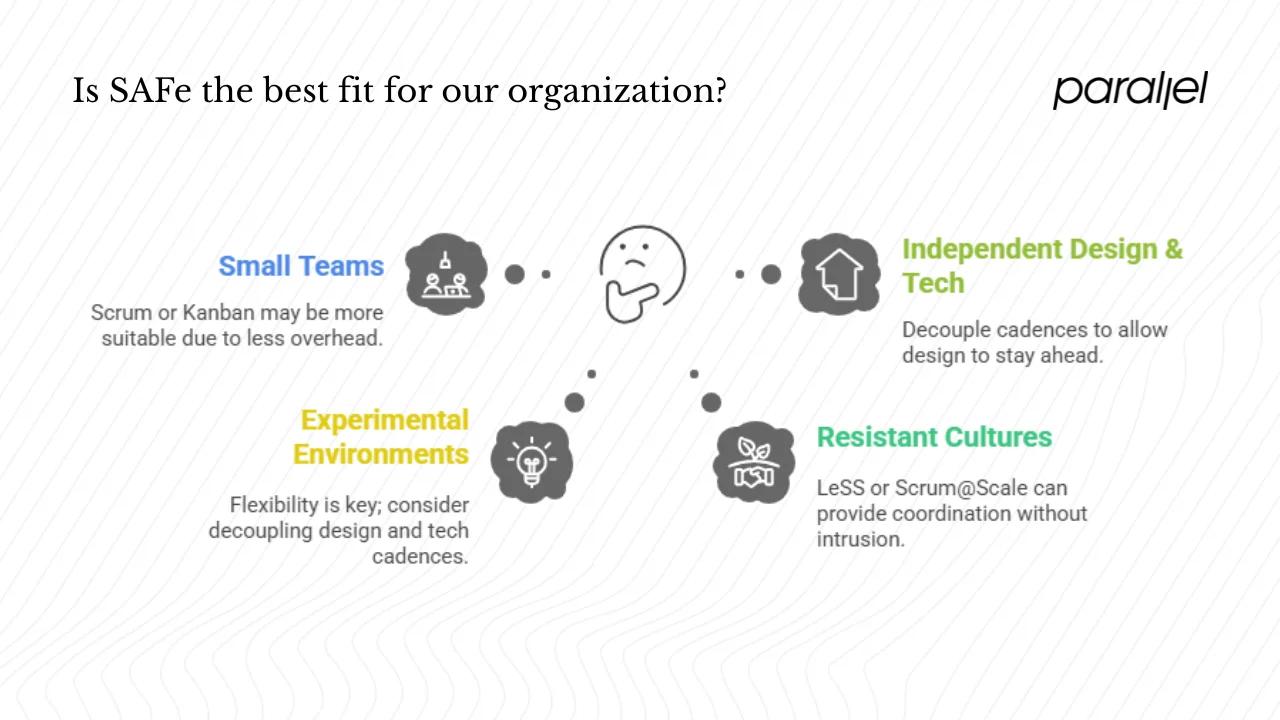
SAFe is not a silver bullet. In many cases a lighter approach is more suitable:
- Small or single‑team startups: If you have fewer than three squads, the ceremony overhead likely outweighs the benefits. Scrum or Kanban at team level may suffice.
- Highly experimental environments: Design‑led startups experimenting with new products may need flexibility to pivot weekly. Heavy cadence and upfront planning can slow them down.
- Cultures resistant to structure: Organisations with a flat, autonomous culture may see SAFe as intrusive. In such cases frameworks like Large‑Scale Scrum (LeSS), Scrum@Scale or a home‑grown hybrid can give needed coordination without as much overhead.
- When design and tech need to move independently: Some projects require design discovery to stay ahead of development. In those cases, consider decoupling research and delivery cadences rather than forcing them into a single Program Increment.
A short comparison: LeSS emphasises minimal rules and uses a single Product Owner across multiple teams; it suits organisations comfortable with self‑organisation. Scrum@Scale extends Scrum events across teams through a Scrum of Scrums and can be lighter to adopt. The Spotify model focuses on culture and trust rather than processes. Choose based on the pain you are trying to solve.
Guidance for Founders, PMs and Design Leaders
As product people, we often ask what does safe stand for in agile because we’re seeking a way to coordinate multiple teams without drowning in process. SAFe offers one answer. Here are some takeaways based on our work with early‑stage SaaS companies:
- Start small and adapt: Piloting an ART around a well‑defined product can reveal whether SAFe’s cadence and roles help or hinder. Use the experience to fine‑tune ceremonies and artefacts. Don’t feel obliged to scale to Portfolio or Full SAFe until you genuinely need them.
- Invest in leadership and learning: Transformation fails when leaders don’t understand lean‑agile principles. Encourage senior stakeholders to attend training and participate in PI planning. The high value placed on learning resources in the SAFe community shows that education pays dividends.
- Focus on value streams and customer outcomes: Whether you use SAFe or not, organise teams around flows of value. Tie program objectives to customer benefits, not internal milestones. Use metrics like cycle time, customer satisfaction and time‑to‑value to steer decisions.
- Encourage cross‑functional collaboration: Bring designers, researchers and engineers together. Create space for specialists and multi‑skilled team members. Use communities of practice to share learning across teams.
- Treat SAFe as a tool, not a destination: The framework exists to serve your strategic goals. If a practice feels heavy, question whether it adds value. If your teams are thriving with a hybrid approach, you may already have your answer.
Ending on a reflective note: scaling agile is less about adopting a brand‑name framework and more about building a culture of trust, clear purpose and continuous learning. If you’re asking what does safe stand for in agile, you’re already doing the right thing—seeking clarity before choosing a path.
FAQs
1) What does SAFe stand for in SAFe agile?
It stands for Scaled Agile Framework. It’s a set of organisational and workflow patterns that help multiple teams apply lean and agile practices across large products. The term underscores scale, agility and structured guidance.
2) What are the four core values or principles of SAFe?
SAFe distinguishes between core values and principles. The four core values are transparency, program execution, built‑in quality and bringing teams together. They describe the culture SAFe advocates. Separately, SAFe is grounded in ten lean‑agile principles such as taking an economic view, applying systems thinking and decentralising decision‑making.
3) What are the 3 C’s in SAFe agile?
The “3 C’s” come from user story practice: Card, Conversation and Confirmation. A story begins as a card (physical or digital), sparks conversations between the team and stakeholders, and includes acceptance criteria to confirm completion. SAFe teams continue to use the 3 C’s to maintain clarity as stories move through program and portfolio layers.
4) What are the seven competencies of SAFe?
SAFe describes seven core competencies: Lean‑Agile Leadership, Team and Technical Agility, Agile Product Delivery (Customer Centricity), Enterprise Solution Delivery, Lean Portfolio Management, Organisational Agility and Continuous Learning Culture. Each competency represents a capability needed for business agility and informs how you scale agile practices.

As the Founder and CEO of Parallel, Robin spearheads a pioneering approach to product design, fusing business, design and AI to craft impactful solutions.