What Does a Chief Product Officer Do? Guide to CPO Roles
Build a successful product organization. Explore the 2026 guide to CPO responsibilities, from vision and architecture to execution and stakeholder alignment.
Table of Contents
As startups grow, product decisions become more complex. Early teams often ask what a chief product officer does because they feel torn between setting a vision and shipping features. I’m Robin Dhanwani from Parallel, and we’ve guided many young software companies through this stage. The role of a chief product officer (CPO) isn’t just another title; it’s a way to create clarity, focus and cohesion around what you build. This article uses real examples and current research to explain why the CPO matters, what the job covers and how to know when you need one.
What does a Chief Product Officer do?
A CPO sits at the top of the product function. ProductPlan describes the position as an executive who leads the entire product organisation, taking responsibility for vision, innovation, design, development and marketing. The same resource notes that this leader mentors product managers and coordinates product marketing and project management. TechTarget adds that a CPO is a senior executive responsible for overall product strategy, development and performance and typically reports to the CEO. They work alongside other executives to set long‑term direction and are accountable for how the product portfolio contributes to business goals.
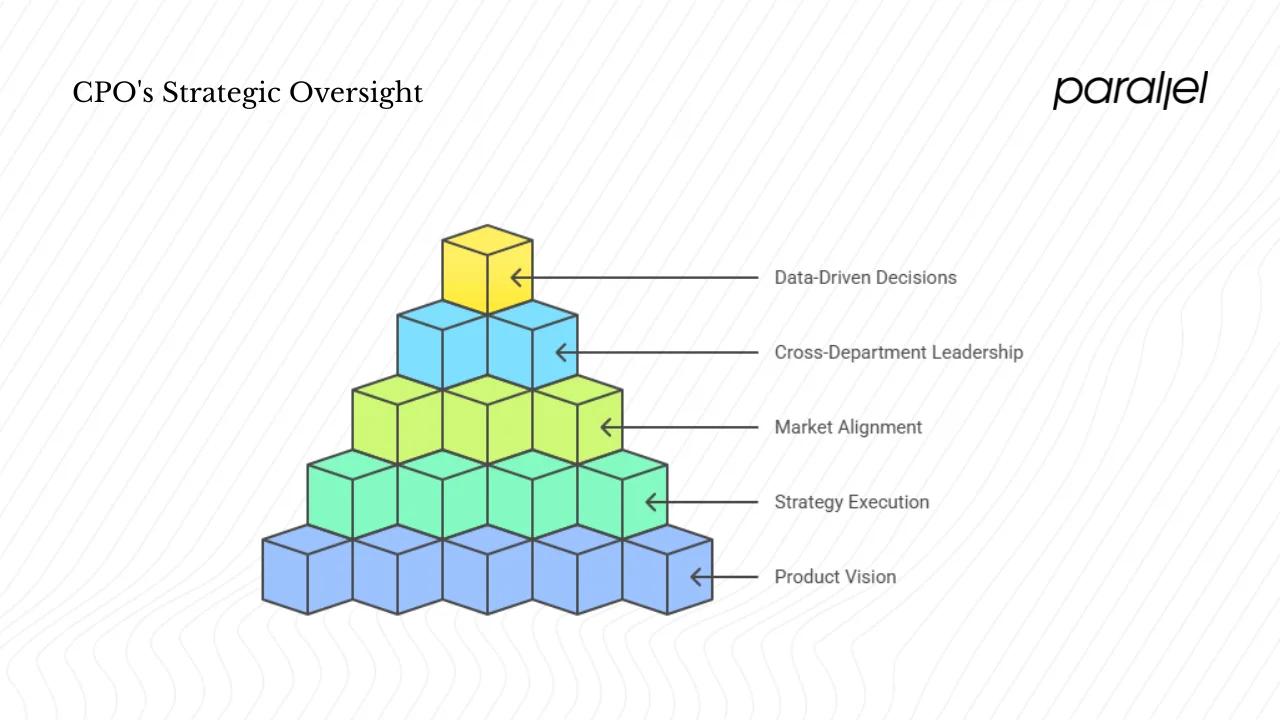
The scope of a CPO goes well past shepherding a single release. ProductSchool explains that the role exists to oversee the company’s entire product strategy from vision to execution. That includes mapping customer needs, shaping roadmaps and making sure the product meets market demands. TechTarget emphasises that today’s CPO must combine product vision with cross‑department leadership, customer‑centric innovation and data‑driven decision‑making. Put simply, they decide what the company should build and why, leaving the technical how to engineering counterparts.
When a startup needs a CPO
Founders often handle product work themselves until the organisation becomes too complicated. As product lines multiply, user segments diverge and headcount grows, that ad‑hoc approach breaks down. ProductSchool notes that small teams can manage without a dedicated product executive, but as a company expands into multiple product lines a senior leader becomes almost essential. Splunk’s guide for product leaders explains that smaller organisations might combine product with other responsibilities, but once complexity increases you need someone who can maintain existing products while developing new ones. In other words, when you spend more time coordinating priorities than shipping value, you may be ready for a CPO.
A clear sign that you need a CPO is organisational misalignment. When roadmaps lack cohesion, user research is ignored and no one can articulate the product vision, the question of what a chief product officer does becomes urgent. Without a senior product leader, teams often pull in different directions and progress stalls.
What a CPO owns
Broadly, the CPO covers six interrelated areas. Each requires both strategic thinking and day‑to‑day involvement.
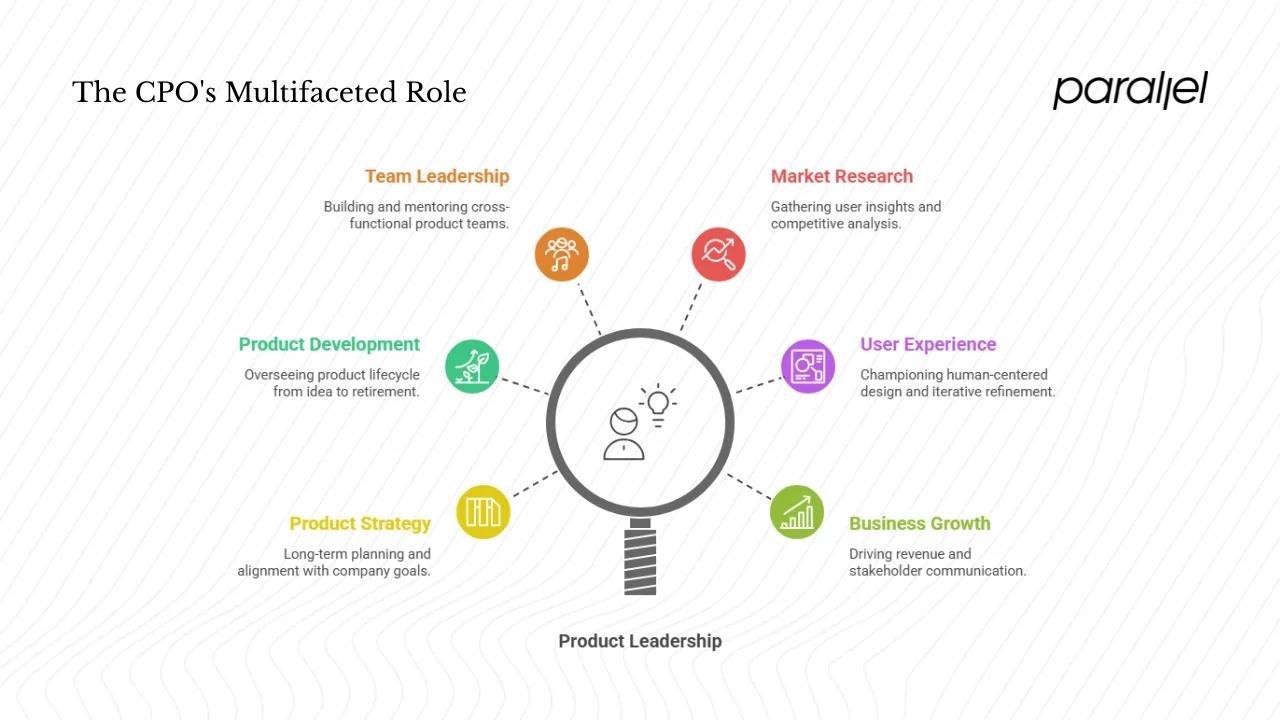
- Product strategy – The CPO sets the long‑term direction for the product portfolio. They decide which customer problems to solve and how the company’s vision translates into a roadmap. ProductSchool emphasises that this person connects customer needs with company goals and product potential. They balance bold bets with incremental improvements and decide which innovations are worth pursuing.
- Product strategy – The CPO sets the long‑term direction for the product portfolio. They decide which customer problems to solve and how the company’s vision translates into a roadmap. ProductSchool emphasises that this person connects customer needs with company goals and product potential.
- Product development and lifecycle – They own the process from idea through retirement, guiding discovery, prototyping, development, launch and iteration. ProductSchool notes that the CPO oversees ideation, development and release and decides when to invest further or sunset features.
- Team leadership and organisation – A CPO recruits and mentors product managers, structures teams around customer segments or product lines and creates an environment where design, engineering, support and marketing work together. TechTarget points out that cross‑functional leadership is core to the job.
- Market research and user insight – Understanding users and competitors is non‑negotiable. The CPO ensures that customer interviews, surveys and usability tests feed into strategy. TechTarget lists customer‑centric innovation and leveraging research as central to the role. Competitive analysis helps the team spot gaps and differentiators.
- User experience and innovation management – The product leader champions human‑centred design. Emeritus reports that companies with strong design outperform the S&P Index by 228 percent. User‑centred design involves understanding people through interviews and usability testing and refining solutions iteratively.
- Business growth and stakeholder communication – A CPO translates product work into business results. Splunk’s guide emphasises that great product leaders act as the organisation’s “Rosetta Stone,” bridging design, engineering, sales and finance. They decide when to introduce new revenue models or enter new markets and communicate the product vision to investors and other stakeholders.
These areas overlap; a strong CPO weaves them together so that discovery informs strategy, roadmap decisions reflect customer feedback and commercial priorities, and the organisation learns from each iteration.
Why this role matters
Strong product leadership correlates with better business performance. An AWS report citing Splunk’s Economic impact of data innovation study found that data‑innovation leaders are 4.6 times as likely to drive more than 20 percent of their revenue from new products and services. Research also shows that organisations with mature design practices outperform the S&P by 228 percent over ten years. In practice a CPO ensures that user research drives decisions, ties product investments to business growth and prevents teams from chasing random ideas.
In our consulting work we’ve seen momentum return to startups once a dedicated product leader synthesised research, guided tough trade‑offs and provided a single point of accountability.
In fast‑moving startups, this coordination is vital. Without a CPO, design, engineering, marketing and sales often pull in different directions. A CPO brings everyone onto the same page and reduces wasted effort. When we ask founders what a chief product officer does, many expect a genius idea generator. The reality is simpler: they are orchestrators and translators who make sure the right problems are solved at the right time.
Day‑to‑day responsibilities
On a daily basis the CPO shifts between vision and action. They refine the product vision by studying market trends, customer pain points and competitor moves, then translate that vision into a roadmap that connects user needs with business goals. They guide discovery, development, release and iteration, using data and feedback to decide which features to prioritise and when to invest, pivot or retire offerings. They hire and mentor product managers, set clear expectations and facilitate rituals that keep design, engineering, marketing and sales connected. They champion research and competitive analysis and work with finance and marketing to link product metrics to revenue and market share, acting as translators between technical teams and business stakeholders. Throughout all of this, they manage the product portfolio by allocating resources across life stages, ensuring experiments happen and sunsetting features when appropriate.
Differentiating the CPO from other leaders
CPO vs VP of Product
CPO vs COO
CPO vs CTO
CPO vs CPTO
Hiring and onboarding a CPO
What to look for in a candidate
- Wide product leadership background. They should have worked across product management, engineering, or marketing and know how these groups think and work.
- A steady, empowering style. You want someone who guides product managers instead of taking decisions out of their hands.
- Experience growing teams. They should know how to hire, coach, set expectations, and build structure without choking creativity.
- Clear strategic direction. They need to shape product vision in a way the company can understand and act on.
- Strong cross-team communication. They must work well with sales, engineering, finance, and leadership, and set clear boundaries so people know who owns what.
Signs your company may need a CPO
- You’re handling several products and the load is starting to fray edges.
- Teams keep raising concerns about shifting priorities.
- Ownership of outcomes is fuzzy and issues bounce around without resolution.
- Different departments push for different product directions and no one is settling the debate.
What the first three months should look like

1. Review the full product set
- What’s working, what’s outdated, and what needs investment.
- How each product ties into the company’s goals.
2. Assess team strengths and gaps
- Skills, workload, roles, and whether responsibilities are clear.
- Where coaching or staffing changes may help.
3. Clarify vision and focus
- Set a simple north star the team can use when making choices.
- Make sure it’s realistic given the company’s stage and resources.
4. Set reporting lines and metrics
- Define who reports to whom.
- Choose a small set of measures the CPO will use to judge progress.
- Keep asking whether they’re spending time on the most important issues.
Metrics and indicators to watch
Product performance and value
- Revenue coming from newer products or features.
- Retention and churn patterns.
- Depth of customer use, feedback trends, interviews, and support tickets.
Delivery and execution
- How often the team ships features, fixes, and improvements.
- Cycle time from idea to release.
- Number and quality of experiments.
Portfolio health
- Age of products and how much each one receives in investment.
- Whether older products are being retired at the right pace.
- Spread of effort across core, growth, and experimental work.
Team wellbeing
- Workload, burnout signals, and clarity of priorities.
- Collaboration across roles.
- Whether people feel they can raise concerns early.
Tracking these areas helps your CPO see issues before they spread. It also gives clear evidence when leadership asks how product work is contributing to the business.
Skills and common challenges of Chief Product Officer

Skills a strong CPO relies on
- Clear long-term thinking. They should be able to picture where the product needs to go over several years and translate that into near-term steps.
- Empathy for customers and teams. They should understand user problems and also know how to motivate and support their staff.
- Decisive prioritisation. They need to shut down distractions, weigh evidence, and choose a path forward.
- Cross-team leadership. They must guide work across engineering, design, sales, and other groups without creating turf wars.
- Good communication. They should explain the “why” behind decisions in simple, honest terms.
Challenges the role tends to bring
- Chasing too many ideas. With so many inputs, it’s easy to sprint after the shiny thing instead of staying focused.
- Getting stuck in day-to-day tasks. Without discipline, they shift from strategy to constant firefighting.
- Micromanagement. Some leaders drift into controlling every detail, which weakens trust and slows everything down.
- Keeping alignment as the company grows. More people, more viewpoints, and more moving parts make it harder to keep everyone pointed in the same direction.
- Staying close to users. It’s easy to drift away from real customer problems as the job pulls them into meetings.
- Wearing too many hats in early companies. They might bounce between strategy, marketing, and operations. A strong team and clear limits keep things from breaking.
Conclusion
The answer to what a chief product officer does depends on a company’s stage, but some themes are constant. A CPO brings customer insight, market awareness and organisational coordination together to create products that drive growth. Understanding this role helps founders decide whether to take it on themselves or hire someone with the right experience. A good CPO keeps the team focused on solving the right problems and turns product work into a driver of revenue and innovation. Keep asking what does a chief product officer do as you scale to ensure the product stays central to your business.
Frequently asked questions
1. Is a CPO higher than a VP of Product?
Generally, yes. A VP typically oversees execution for part of the product portfolio, while the CPO defines the overarching vision and reports to the CEO. ProductSchool explains that a VP may focus on delivery, whereas the CPO has a company‑wide remit. However, titles vary; in some startups the head of product or VP may effectively act as the CPO.
2. What is the difference between a CPO and a COO?
The COO manages operations across the business—processes, budgets and resources—while the CPO decides what the product should be and why. Operations leaders focus on efficiency; product leaders focus on solving customer problems in a way that drives the business.
3. How much do chief product officers make?
Salaries vary by location and company size. A job board’s data from October 2025 puts the average base salary for CPOs in the United States at about $199,625, with a range from $116,100 to $343,240. ProductSchool lists an average of $293,180 with a typical range of $263,480 to $327,480. Other sources summarised by Splunk show figures between roughly $230,000 and $296,000 plus bonuses. Compensation depends on responsibility, stage and location.
4. What makes a great CPO?
It’s a combination of strategic vision, empathy for users, communication skill and the ability to build and lead teams. A good CPO loves the craft of building products but knows when to delegate. They are comfortable with data and can connect product outcomes to business results. Broad experience across product domains helps because it teaches them how products create value at different scales.

As the Founder and CEO of Parallel, Robin spearheads a pioneering approach to product design, fusing business, design and AI to craft impactful solutions.


